


Europe’s First Natural Hydrogen Map:
What the EC’s Getech Contract Means for the Sector
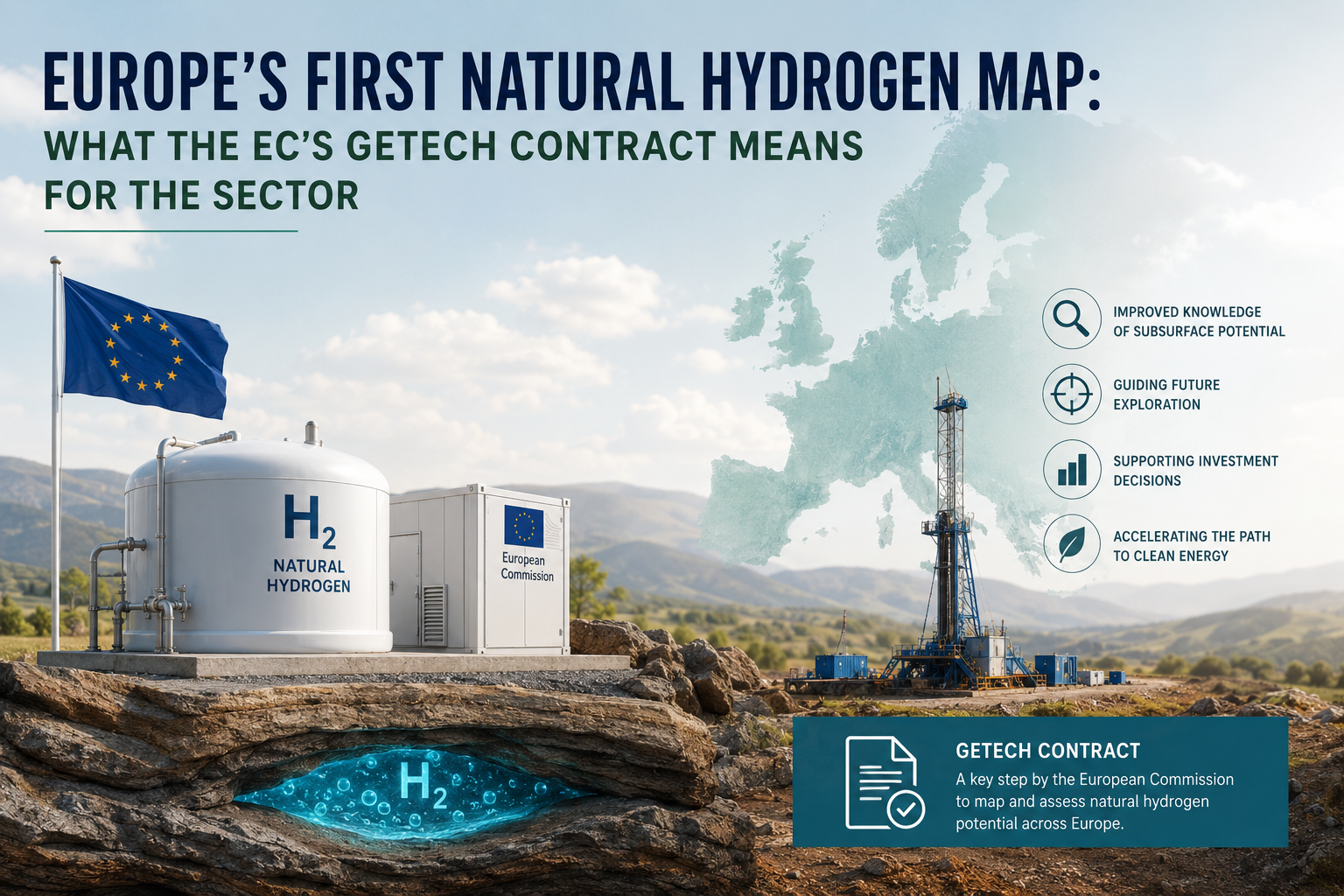
On 23 July 2026, the European Commission awarded a landmark contract worth more than €1 million to a consortium led by Trinomics B.V. and including Getech as its primary geological delivery partner. The mandate: produce the first pan-European assessment of natural hydrogen subsurface potential and develop the regulatory framework needed to govern its sustainable production. This is not a discovery announcement. It is something different — and in some ways more significant. It is the European Union officially treating natural hydrogen as a resource that exists at scale, needs to be mapped, and requires legislation. Three years ago, that sentence could not have been written.
What Was Commissioned — The Exact Scope
The study’s official title, as stated in the European Commission’s contract documentation, is: “Mapping underground reservoirs of natural hydrogen in Europe and developing the necessary legislation for sustainable production.” It was commissioned by the Directorate-General for Internal Market, Industry, Entrepreneurship and SMEs (DG GROW) — the Commission body responsible for industrial policy and energy markets, not a research agency. This is a policy-facing mandate, not an academic exercise.
The consortium is led by Trinomics B.V., a Rotterdam-based economic and policy consultancy specialising in energy transition analysis. Getech — a Leeds-based geological data and subsurface resource company listed on AIM — is the primary technical delivery partner, responsible for the geological components of the study. Getech’s selection is significant: the company holds one of the world’s most comprehensive proprietary datasets for subsurface geological analysis, built over decades of work for oil and gas, mining and geothermal clients globally.
Natural hydrogen does not sit in obvious underground pockets waiting to be tapped. It is generated continuously by geochemical reactions — primarily serpentinisation (iron-rich rocks reacting with groundwater at depth) and radiolysis (radioactive decay splitting water molecules) — and migrates upward through fault networks and permeable rock formations.
Mapping the potential means identifying which geological settings across Europe are most likely to host these reactions at depth, which rock formations could act as traps accumulating migrating hydrogen, and where surface flux measurements (detectable hydrogen seeps) correlate with promising subsurface structures. Getech does this using a combination of seismic data, borehole logs, gravity and magnetic surveys, geochemical databases, and AI-driven pattern recognition across its proprietary global dataset.
The output is not a map of confirmed deposits. It is a prospectivity map — a probabilistic assessment of which regions within the EU have the highest geological likelihood of hosting economic natural hydrogen accumulations. Think of it as the equivalent of an initial oil and gas basin study: the essential first step before any exploration company can rationally decide where to drill.
Why Now — The Context That Made This Possible
This contract would not have been awarded two years ago. Three developments have shifted the Commission’s calculus from “interesting research topic” to “policy priority requiring legislation.”
First, the Lorraine Basin. The REGALOR II programme, led by Française de l’Énergie with CNRS researchers Jacques Pironon and Philippe De Donato, has progressively de-risked the geological case for natural hydrogen in the Paris Basin and Moselle sub-basin. The Folschviller borehole confirmed concentrations at 1,100 metres. PTH-2 at Pontpierre — drilled to 3,655 metres, the world’s deepest well dedicated exclusively to natural hydrogen — confirmed concentrations of 36.1% at 2,242 metres and 49.6% at 2,426 metres on 23 June 2026. These are among the highest natural H₂ concentrations ever recorded in situ globally. France has issued its first natural hydrogen exploration permit — the “Trois Évêchés” permit — covering 2,254 km² in Moselle and Meurthe-et-Moselle. First commercial production is targeted for late 2028.
Second, the Albanian discovery. Research published in Science in February 2024 (Truche et al.) confirmed that the Bulqizë chromite mine in Albania was emitting approximately 200 tonnes of natural hydrogen per year at 84% purity — the largest natural hydrogen flux ever measured globally. The geological formation responsible is a Jurassic ophiolite: a rock type present at multiple locations across Europe, from the Balkans to the Iberian Peninsula to the Alps.
Third, the global investment signal. Koloma, a US natural hydrogen exploration company, has raised $245 million — the largest private investment in natural hydrogen globally. Gold Hydrogen Ltd in Australia confirmed 97% purity at its Ramsay 3 borehole in December 2025. The University of Toronto published results in PNAS in May 2026 confirming continuous natural hydrogen discharge over decades in Precambrian shield rocks. The Commission is watching a sector move from scientific curiosity to investment target at speed.


What the Study Will Deliver — Two Outputs, One Deadline
The 12-month study running through FY26 and FY27 has two distinct deliverables:
Deliverable 1 — The Geological Map. Getech will produce the first continent-scale prospectivity assessment for natural hydrogen across all 27 EU member states. This means identifying geological settings favourable for natural hydrogen generation (serpentinisation zones, Precambrian basement rocks with uranium-bearing formations, ophiolite sequences), mapping structural traps that could accumulate migrating hydrogen, and integrating available surface flux and borehole data. The map will not confirm deposits — it will identify where exploration is most likely to find them.
Deliverable 2 — The Regulatory Framework. Trinomics will develop the policy architecture that Europe needs to govern natural hydrogen exploration and production. Currently, natural hydrogen falls into a regulatory gap: it is not covered by oil and gas legislation (which governs hydrocarbons), not covered by renewable energy legislation (which governs manufactured green hydrogen), and not covered by mining law in most member states. France is the first EU country to issue a natural hydrogen exploration permit — and it had to create a bespoke legal instrument to do so. The study will propose harmonised EU-level definitions, permitting frameworks, resource classification standards, and safety and environmental requirements.
- WILL establish — geological settings most favourable for natural H₂ across all 27 EU member states · prioritised exploration targets by country and region
- WILL establish — first EU-level regulatory framework for natural hydrogen exploration and production permits
- WILL establish — resource classification methodology — the European equivalent of a “reserve/resource” category system for natural hydrogen
- WILL NOT establish — confirmed deposits in any member state · this is prospectivity mapping, not exploration drilling
- WILL NOT establish — commercial viability of any specific site — that requires follow-on exploration by private companies
- WILL NOT establish — production cost estimates for specific European sites — costs depend on depth, flow rate and infrastructure, none of which are known until wells are drilled
The Timeline — From Commission Mandate to First Permits
What It Means for the Sector — Six Concrete Implications
As hydrogen establishes itself as a pillar of the global energy transition, Getech’s proprietary datasets and geoscientific insight will be of growing importance to governments, energy companies and regulators worldwide.
Getech Group plc · Official statement · 23 July 2026The Honest Assessment — What This Does Not Change
The Commission’s mandate is a significant institutional signal. It is not a discovery, a production announcement or a cost confirmation. The honest analysis requires stating clearly what the study will not resolve.
The study will not confirm commercial deposits anywhere in Europe. A prospectivity map identifies where exploration is most promising — it does not replace exploration. The gap between “geologically favourable setting” and “commercially viable deposit” is filled by years of exploration drilling, flow testing, and resource certification — exactly the process FDE is undertaking in Lorraine.
The regulatory framework will take time to translate into law. EU legislative processes typically take two to four years from Commission proposal to member state implementation. Even if the study is completed in H2 2027, a harmonised EU natural hydrogen permitting framework is unlikely to be operational before 2029–2030 at the earliest.
Getech’s map will not resolve the cost question. Whether European natural hydrogen can be produced at €0.50–1.00/kg — the price point that changes the economics of e-fuels and green ammonia — depends on flow rates, well depths, infrastructure costs and reservoir behaviour. None of these can be determined from surface mapping alone. PTH-2 in Lorraine is the model: years of geological work followed by a deep well, followed by flow testing, followed by resource certification. The EU study accelerates the targeting phase of that process. It does not short-circuit the rest.
Conclusions — The Threshold That Has Been Crossed
The European Commission has crossed an institutional threshold. By commissioning a geological map and a regulatory framework simultaneously, it is treating natural hydrogen not as a scientific hypothesis but as a resource category that will require industrial governance. That is new. That matters.
The pace of development is accelerating. In January 2026, France issued the first natural hydrogen exploration permit in EU history. In March 2026, Belgium launched its geological survey programme. In June 2026, FDE confirmed record concentrations at PTH-2. In July 2026, the Commission funded the first continental map. These are not coincidences — they are the compounding effects of a sector that has crossed the credibility threshold and is now attracting institutional attention.
The map Getech will produce is the missing piece of the puzzle that exploration companies, infrastructure investors and policymakers have all been waiting for. It will not confirm European natural hydrogen as a commercial resource. But it will tell the world — for the first time, with the authority of a European Commission mandate — where on this continent that resource is most likely to be found.
That is the question that every serious actor in natural hydrogen has been asking since Lorraine. The answer is now being formally researched, at EU scale, on a 12-month timeline. The sector will not be the same when the answer comes back.
Source accuracy: All facts in this article are drawn from publicly available primary sources published on or before 26 July 2026, cited in the sources section below. naturalhydrogen.ai makes reasonable efforts to ensure accuracy but cannot guarantee the completeness or timeliness of information. Readers are advised to verify all information independently, particularly regulatory and commercial data, before making any decision.
Not investment advice: This article is produced for informational and educational purposes only. Nothing in this article constitutes financial, investment, legal or commercial advice. BESS Energie SRL and naturalhydrogen.ai have no financial interest in any company mentioned in this article, including Getech Group plc, Trinomics B.V., FDE, or any other named entity.
Prospectivity vs discovery: This article explicitly and repeatedly states that the Getech/Trinomics study will produce a geological prospectivity assessment — not a confirmation of deposits. No claim is made that natural hydrogen has been discovered or confirmed as commercially viable in any EU member state other than in the specific geological data cited for France (FDE/REGALOR II) and Albania (Bulqizë, Science 2024). Regarding Belgium specifically: no natural hydrogen accumulation, flow, or commercially exploitable resource has been confirmed on Belgian territory as of the publication date of this article.
Forward-looking statements: Timelines, cost projections and regulatory outcomes are projections based on publicly available information. They carry execution risk and may differ materially from actual outcomes. The 2027 study completion date and 2028–2030 regulatory framework timelines are estimates derived from the stated 12-month contract duration and typical EU legislative process timelines.
Copyright: Content © 2026 BESS Energie SRL · BCE 0698.949.732 · naturalhydrogen.ai · All rights reserved. Reproduction permitted with attribution to naturalhydrogen.ai and a link to this article.
- → Getech Group plc — Official regulatory announcement — “Getech Wins Landmark €1M+ European Commission Natural Hydrogen Contract” — 23 July 2026 — energy-pedia.com / TradingView / Fuel Cells Works
- → H2-Mobile.fr — “L’Europe lance la première cartographie de son potentiel en hydrogène naturel” — Michaël Torregrossa — 24 July 2026
- → Hydrogen Insight — “EU commissions study to map natural hydrogen hotspots in Europe” — 23 July 2026
- → FDE (Française de l’Énergie) — Official press release PTH-2 results — 23 June 2026 — actusnews.com
- → Truche L. et al. — “Hydrogen gas emissions from a deep ultramafic rock: the Bulqizë ophiolite” — Science, February 2024
- → FDE — “Trois Évêchés” exploration permit — January 2026 — French Ministry of Energy
- → Belgian government — BE.Hydrogen programme announcement — Minister Jean-Luc Crucke — March 2026
- → PNAS — University of Toronto natural hydrogen discharge study — May 2026
- → Gold Hydrogen Ltd (ASX) — Ramsay 3 borehole results — December 2025