

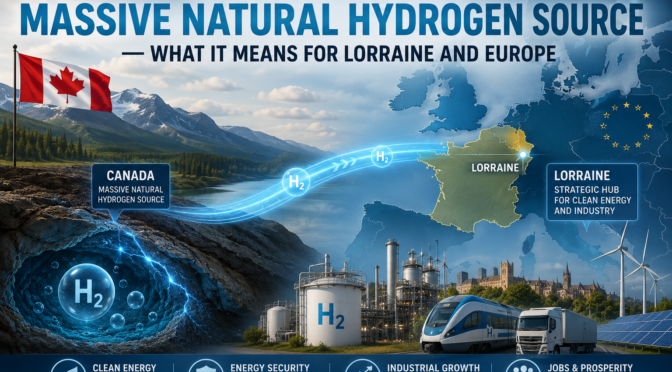

Canada Confirms Massive Natural Hydrogen Source —
What It Means for Lorraine and Europe
Scientists at the University of Toronto have confirmed that ancient rocks deep beneath the Canadian Shield continuously release natural hydrogen gas — a discovery published in the Proceedings of the National Academy of Sciences on May 20, 2026. Combined with the ongoing REGALOR II drilling programme in Lorraine and Belgium’s newly launched BE.Hydrogen national exploration programme, the evidence is converging: the Earth is a hydrogen factory, and humanity is only beginning to understand the scale of what lies beneath.
The Canadian Discovery — What Scientists Found
A research team led by Professor Barbara Sherwood Lollar at the University of Toronto spent a decade collecting groundwater samples from boreholes drilled up to 1.8 miles underground in the ancient Precambrian rocks of the Canadian Shield. Their findings, published in the Proceedings of the National Academy of Sciences on May 20, 2026, confirm that these geological formations are continuously and measurably releasing natural hydrogen over decadal timescales.
The rocks involved are among the oldest on Earth — some estimated at several billion years old. The chemical process responsible is serpentinisation: iron-rich minerals react with deep groundwater, oxidise, and release hydrogen gas as a continuous natural byproduct. The Toronto team’s ten-year monitoring programme provides the first long-term evidence that this is not an episodic phenomenon but a stable, ongoing geological process.

The study’s authors are explicit about the global implications. “There is a global race to increase hydrogen availability in order to decarbonize and reduce the costs of the existing hydrogen economy,” says Professor Sherwood Lollar. “We now have a better understanding of the economic viability of this resource that can be mapped to hydrogen deposits around the world that are both already known and yet to be discovered.”
The largest concentrations detected in the Canadian study appear in geological regions already associated with mining activity — Northern Ontario, Quebec, Nunavut, and the Northwest Territories. The common geological link is the ancient iron-rich rock itself, which is the same geological signature present in the Lorraine basin and the former mining zones of Wallonia.
The Lorraine Connection — Europe’s Equivalent
The Canadian findings directly reinforce what CNRS researchers Jacques Pironon and Philippe De Donato discovered in the Lorraine basin over a decade ago. The geological conditions are strikingly similar: ancient iron-rich Hercynian basement rocks, deep groundwater circulation, and the continuous production of hydrogen through serpentinisation.
What makes Lorraine exceptional is the scale of the accumulation. Updated estimates now place the potential Lorraine deposit at up to 92 million tonnes — revised upward from the initial 46 million tonne estimate as the REGALOR II borehole at Pontpierre, Moselle, drilled to 3,655 metres in October 2025, confirmed strong hydrogen concentrations at depth.

The French government’s publication of the “Trois Évêchés” exclusive exploration permit in January 2026 — covering 2,254 km² in Moselle and Meurthe-et-Moselle — marked the first time France had ever granted a geological hydrogen exploration permit. The regulatory framework is now in place. The geological evidence is mounting. The only remaining question, as the Toronto researchers would frame it, is one of economic viability at scale.
The Canadian discovery is not a separate story from Lorraine. It is the same story, told in a different language, on a different continent. The geological process is identical. What Canada confirms is that the Lorraine accumulation is not an anomaly — it is a manifestation of a global phenomenon.
naturalhydrogen.ai · Editorial analysis · May 2026Belgium Joins the Race — BE.Hydrogen Launched
On May 27, 2026 — the same week the Canadian study received global media attention — Belgium announced the launch of its national geological hydrogen exploration programme, BE.Hydrogen, coordinated by the Geological Survey of Belgium and facilitated by Belspo, the Belgian Federal Science Policy Office.
Belgian Federal Minister Jean-Luc Crucke personally visited the REGALOR II borehole site at Pontpierre on May 27, signalling that the Belgian government is treating natural hydrogen as a matter of national strategic importance. The BE.Hydrogen programme will deliver its first geological evaluation in spring 2028.

The geological rationale is strong. Belgium’s former coal basins share the same ancient Hercynian basement as Lorraine — the same iron-rich formations, the same deep groundwater systems, the same conditions for serpentinisation. The Ardennes massif in southern Belgium offers additional exploration targets. A Belgian natural hydrogen deposit, if confirmed, would transform the Greater Region into Europe’s first autonomous geological hydrogen territory.
The Global Race — Who Is Exploring Where
The Canadian and Lorraine discoveries are part of a rapidly accelerating global pattern of natural hydrogen exploration. The convergence of scientific evidence, regulatory frameworks and commercial investment is creating what may become one of the most significant energy exploration cycles since the North Sea oil boom.
- France / Lorraine — REGALOR II at 3,655m · “Trois Évêchés” permit 2,254 km² · FDE · results 2027
- Belgium — BE.Hydrogen national programme launched May 2026 · Belspo · results 2028
- Canada — University of Toronto PNAS study May 2026 · MAX Power Saskatchewan drilling · “Genesis Trend” 475 km
- USA — Oklahoma State University $25,000 state survey July 2026 · Koloma raised $245M · USGS assessment ongoing
- Australia — Gold Hydrogen extensive basin surveys · South Australia · Yorke Peninsula
- Mali — Bourakebougou · only active commercial production globally · ~5 kg/day · village electricity
- Spain / Pyrenees — French-Spanish Pyrenean basin · preliminary surveys · promising geology
- Oman / Albania — ophiolite belts · known H₂ seeps · exploration permits under review
What is striking about the current moment is the convergence of three independent developments: the scientific confirmation of long-term stable production (Canada), the regulatory framework enabling commercial exploration (France), and the institutional government support (Belgium). All three arrived within months of each other in 2026.
What This Means for E-Fuels — The Economics Change
The significance of natural hydrogen extends far beyond hydrogen itself. At a production cost target of €0.50 per kilogram — compared to €6.20/kg for electrolytic green hydrogen today — natural hydrogen would transform the economics of every Power-to-Liquid synthetic fuel:
- eSAF aviation fuel — from €7.70/L today → ~€3.00/L · approaches ReFuelEU mandate viability
- e-Petrol road fuel — from €3.40/L today → ~€1.80/L · approaches pump price parity
- e-Methanol maritime — from €920/t today → ~€300/t · competitive with fossil methanol
- e-Ammonia maritime — from €720/t today → ~€280/t · competitive with grey ammonia
The EU’s 2035 ICE vehicle ban exemption for certified e-fuels, combined with ReFuelEU Aviation mandates requiring 6% SAF by 2030 and 70% by 2050, creates the regulatory demand. Natural hydrogen at scale provides the missing cost reduction. The HY4Link cross-border hydrogen pipeline — connecting Lorraine through Luxembourg to Belgium and Germany — provides the transport infrastructure. The Greater Region has all the pieces.
What Happens Next — The 2027 Decision Point
The critical date is 2027. REGALOR II full results will determine whether the Lorraine deposit is commercially viable at industrial scale. If confirmed, the sequence is relatively straightforward: exploitation permit application 2028–2029, pilot production 2030–2031, industrial scale 2032–2033.
The Canadian study adds weight to the geological case. The BE.Hydrogen programme adds institutional legitimacy. The global exploration race adds competitive urgency. The question is no longer whether natural hydrogen exists in sufficient quantities — the science confirms it does across multiple continents. The question is how quickly the technology, regulation and infrastructure can align to extract it economically.
For the Greater Region — Belgium, Luxembourg, France and Germany — the alignment is already further advanced than anywhere else in the world. The window is open. What happens in Pontpierre in 2027 will determine whether it stays open.
- → University of Toronto / Sherwood Lollar & Warr — PNAS May 20, 2026 — “Decadal record of continental H₂ reservoirs”
- → ScienceDaily — “Scientists discover massive natural hydrogen source beneath Canada” — May 20, 2026
- → Smithsonian Magazine — “Canadian Mine Might Release Natural Hydrogen” — May 21, 2026
- → RTBF — “Hydrogène naturel : la Belgique s’appuie sur l’exemple français pour avancer” — May 27, 2026
- → MAX Power Mining — “Canada’s First Natural Hydrogen Drilling Discovery — Saskatchewan” — Jan 2026
- → CNRS / GeoRessources — Pironon & De Donato — University of Lorraine — 2012–2023
- → FDE / REGALOR II — Pontpierre borehole 3,655m — October 2025
- → Journal Officiel français — “Trois Évêchés” H₂ exploration permit — January 2026
- → discoveryalert.com.au — “White Hydrogen Exploration 2026” — Jan 2026